
Key Takeaways
- Precision stamping forms metal without removing it. A die shears or shapes sheet stock into a finished part in one or more press strokes. Nothing is cut away as chips the way it is in machining.
- The tooling determines the result. Part quality is decided when the die is built, not adjusted afterward. This is why die design and maintenance matter more than press tonnage.
- Thin material demands a different technique. Below roughly .010 inch, burr control, flatness, and handling govern the outcome. Shops accustomed to heavy gauge often struggle in this range.
- Volume economics favor stamping. Once tooling exists, the cost per part drops well below machining for the same geometry. The crossover point comes earlier than most engineers assume.
- Tooling ownership affects your total cost. Who pays for the die, and who stores it, changes the economics of every reorder. Ask before the first purchase order, not after.
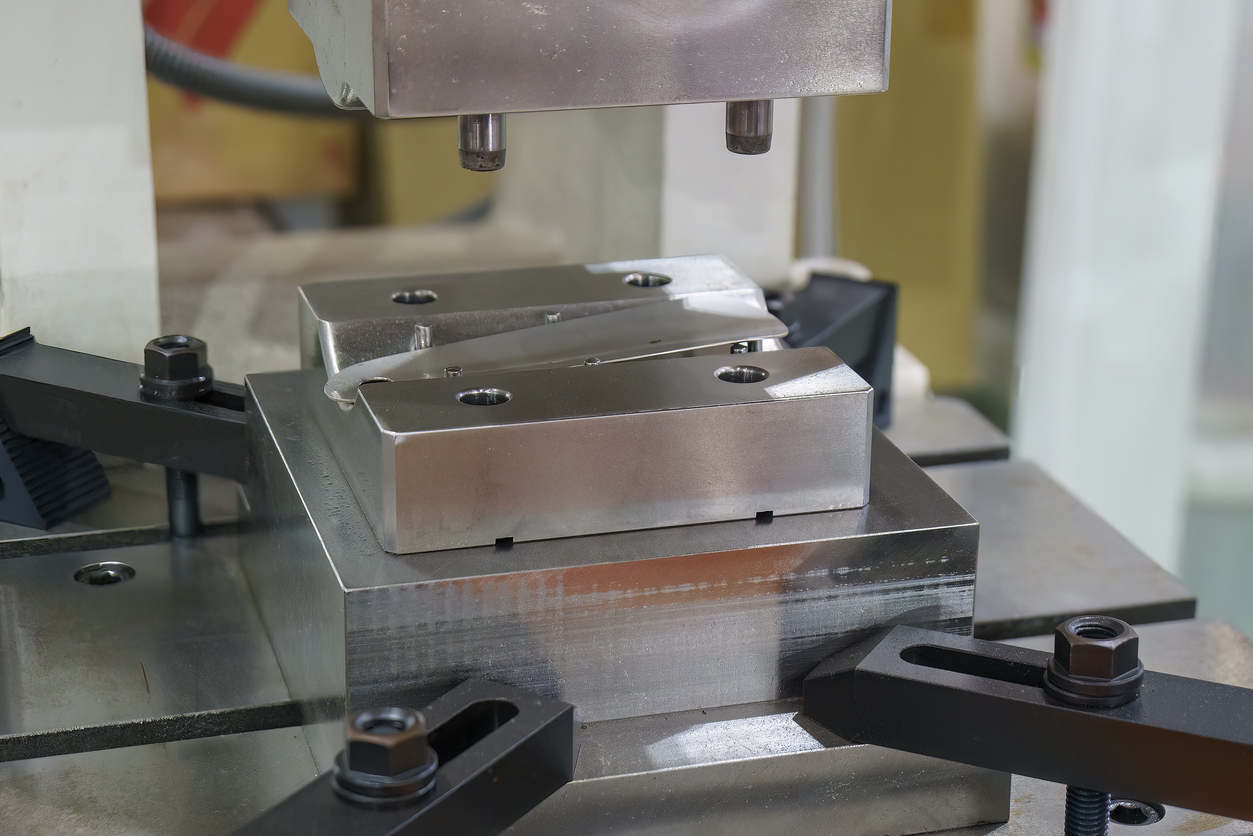
Precision stamping is a metal forming process in which sheet or coil stock is placed into a die and formed by a press into a finished part. The press supplies force, the die supplies the geometry, and the material takes the shape the die dictates. It is a forming operation rather than a cutting one, which is the fundamental difference between stamping and machining.
The word precision separates the work from general sheet metal fabrication. A stamped bracket for a cabinet and a stamped shim held to .0005 inch use the same basic principle and almost nothing else in common. The tolerance target changes the tooling, the material handling, and the inspection method.
We have run precision stamping operations since 1919, and here is how the process works in a shop producing flat parts to tight tolerances.
How the Process Works
Material arrives as coil or sheet and is inspected before it reaches a press, because a thickness variation in incoming stock becomes a thickness variation in every part made from it. The stock is fed into the die, and the press cycles, with each stroke performing one or more operations. Finished parts are deburred, inspected against the print, and packaged with their documentation, all within our own facility as described on our about us page.
A blanking operation cuts the outer profile from the stock. Piercing creates the inside diameter or any additional holes. Forming operations bend or draw material out of plane, though many precision flat parts require no forming at all beyond the initial shear.
Progressive dies combine several of these operations into one tool, advancing the strip through successive stations so a finished part exits at the end of the sequence. Simpler flat parts often run in a single-station die instead. Which approach makes sense depends on geometry and quantity.
The Core Stamping Operations
Most precision flat parts use some combination of the operations below. Understanding which ones your part requires helps explain where its cost and its tolerance limits come from.
- Blanking: Shearing the outer profile of the part from the parent material in a single stroke.
- Piercing: Punching holes, slots, or an inside diameter within the blank.
- Coining: Compressing material to improve flatness or refine a dimension.
- Forming and bending: Moving material out of the flat plane to create a three-dimensional feature.
- Deburring: Removing the raised edge left by shearing, which matters most in thin stock.
Why Tooling Is the Whole Game
A press is a source of controlled force. The die is what turns that force into a part, and every dimension your print specifies is built into steel before the first piece is produced. A well-built die produces the thousandth part the same as the first; a marginal one drifts, and the drift shows up as dimensional creep that inspection has to catch.
Die clearance governs edge quality. Too little and the tool wears quickly; too much and the part shears with an unacceptable burr and rollover. Getting that clearance right for a given material and thickness is experience rather than a formula, and it is a large part of why we build and maintain our own tooling for the precision parts we manufacture.
Tooling cost is also where supplier terms differ most. Many shops charge for die construction, then charge again if the tool needs rework. We do not charge for tooling, and we store it, so repeat orders start from an existing setup.
Materials and Their Behavior
Material choice affects tooling life, achievable tolerance, and cost per part in ways that are easy to underestimate at the design stage. The notes below reflect how each behaves under a die rather than how it performs in service.
- Stainless steel: Work hardens as it forms, requiring more tonnage and careful clearance in hard tempers.
- Copper and brass: Form readily and shear cleanly, favored where conductivity or sealing is required.
- Aluminum: Light and easy to form, though soft enough that handling damage becomes a real concern.
- Phosphor bronze and beryllium copper: Chosen for spring characteristics and used where a part must flex predictably.
- Inconel and Monel: Tough, high-temperature alloys that demand more from tooling and shorten die life.
- Engineered plastics and films: PTFE, Nylatron, Mylar, and Kapton stamp cleanly with the right tooling and no burr concern.
Precision Stamping Compared to Other Methods
Machining removes material to reach a shape, providing excellent dimensional control on complex geometry but consuming time proportional to the amount removed. For a flat washer or shim, machining each part individually is slow and expensive compared to a press producing parts per stroke. Laser and waterjet cutting sit between the two, offering fast setup without dedicated tooling but slower cycle times and different edge characteristics across the materials we stock.
Wire EDM occupies its own niche. It cuts extremely tight profiles in hard materials with no tool pressure, making it valuable for prototypes and unusual shapes, but it is slower than stamping for any meaningful quantity.
The practical rule is that stamping wins on quantity and repeatability, while machining and EDM win on one-off complexity. For a customer who needs fifty parts now and several hundred later, stamping is usually the better answer even at the first order.
When Precision Stamping Is the Right Choice
Stamping is not the answer for every part. The characteristics below point clearly toward a press rather than another process.
- Flat or lightly formed geometry: Parts whose shape can be produced in a die rather than carved from stock.
- Repeat production: Any part you will order more than once benefits from an existing die.
- Thin material: Stock too thin to hold securely for machining is well suited to stamping.
- Consistency requirements: A die reproduces the same geometry every stroke, which machining setups cannot match economically.
- Cost sensitivity at volume: Piece price falls sharply once tooling exists, particularly with no tooling charge to recover.
Specifying a Stamped Part
A well-specified print shortens quoting and reduces the chance of a first article surprise. Four callouts do most of that work.
- Call out the controlling dimension: Tell the manufacturer which feature determines whether the part functions.
- Specify burr direction: In thin parts, which face carries the burr affects how the assembly seats.
- State flatness separately: Thickness and flatness are different requirements and need separate callouts.
- Name the material and temper: Hardness changes forming behavior, so 302 full hard and 302 annealed are not interchangeable.
Where a stamped washer must meet a published dimensional standard, ASTM F844 covers plain unhardened steel washers for general use. Most of what we produce is built to a customer print rather than a table, across the applications we serve.
It also helps to say how the part is used. A dimension that looks arbitrary on a drawing often turns out to be the one feature that has to be perfect, and knowing that changes how we set up the job.
Talk to Brewster Washers About Your Stamped Part
Precision stamping rewards planning far more than it rewards reaction. Decisions made during die design determine what the process can hold, which is why the most useful conversation happens before tooling is built, not after a first article fails.
Send us your print, and we will tell you what we can hold and what it will cost, with no tooling charge and a quote within 24 to 48 hours. Request a quote from Brewster Washers.