
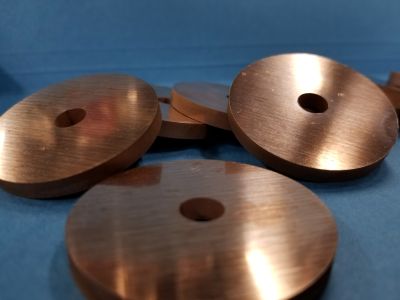
Standard steel and stainless steel washers serve general-purpose applications adequately, but demanding environments require specialty washer materials with unique properties. We’ve manufactured specialty washers and spacers from exotic alloys, high-performance plastics, and engineered materials for over a century. Understanding the capabilities of different specialty materials helps engineers optimize designs for extreme conditions.
Specialty washer materials excel in applications where standard options would fail due to corrosion, temperature, conductivity, or weight requirements. Aerospace, medical, marine, and high-performance industries rely on these advanced materials daily. Each specialty material offers specific advantages that justify the premium cost over standard steel options.
High-Performance Metal Specialty Washers
Four primary high-performance metals dominate specialty washer applications:
- Titanium Specialty Washers: Offering the highest strength-to-weight ratio, titanium excels in aerospace structures, medical implants, and corrosive marine environments where weight and corrosion resistance are paramount considerations
- Inconel Specialty Washers: This nickel-chromium superalloy withstands high temperatures while maintaining strength, making it essential for gas turbine engines, exhaust systems, and high-temperature furnace applications requiring extreme heat resistance
- Monel Specialty Washers: Combining excellent corrosion resistance in seawater and acids with good strength, Monel serves marine hardware, chemical processing equipment, and offshore oil platform assemblies exposed to harsh environments
These high-performance metals represent our most frequently specified specialty washer materials beyond standard stainless steel. Each alloy was developed to address specific engineering challenges that commodity materials cannot adequately address. The premium pricing reflects both raw material costs and the specialized processing required for manufacturing.
Why Specialty Washers Matter in Critical Applications
Specialty washers prevent catastrophic failures in applications where standard materials would degrade rapidly under operating conditions. Corrosive environments can attack steel, including stainless steel, leading to thinning, pitting, and eventual structural failure. Temperature extremes cause standard materials to lose strength, creep, or become brittle, compromising joint integrity.
The cost of using inappropriate washer materials far exceeds the premium for specialty options in any risk analysis. A $20 titanium washer that prevents a $500,000 aircraft engine failure represents obvious value when evaluating total risk. Medical implants require biocompatible materials to avoid patient complications and liability exposure that could reach into the millions.
We’ve witnessed failures resulting from engineering teams specifying standard materials to save costs in critical applications without understanding the consequences. The subsequent recalls, warranty claims, and reputation damage dwarf the material cost savings many times over. Specialty washers and spacers exist specifically to prevent these failures in demanding environments.
Failure Modes Prevented by Specialty Materials
Crevice corrosion occurs when moisture and contaminants concentrate in the washer-to-substrate interface, creating localized attack. Standard steel washers rust and expand, loosening the joint and causing structural degradation over time. Specialty corrosion-resistant materials, such as titanium and Monel, prevent this failure mode entirely through passive oxide layers.
Stress corrosion cracking results from the combination of tensile stress and corrosive environment attacking standard stainless steel in specific conditions. Marine applications and chloride-bearing industries experience this regularly with 304/316 stainless washers exposed to salt spray. Upgrading to specialty alloys eliminates cracking by improving metallurgy.
High-temperature oxidation and scaling destroy standard steel washers in exhaust systems and furnace applications. The oxide layers that form reduce the effective washer thickness and contaminate assemblies with scale particles. Inconel and other high-temperature specialty washers maintain integrity through thousands of thermal cycles.
Copper Alloy Specialty Washers
Copper-based alloys offer unique combinations of properties unavailable in ferrous materials:
- Pure Copper Washers: Excellent thermal and electrical conductivity (100% IACS) makes copper ideal for electrical connections, heat sinks, and sealing applications requiring thermal transfer, like automotive head gaskets and electrical busbars
- Brass Specialty Washers: Combining copper and zinc, brass offers moderate strength, good corrosion resistance, and attractive appearance for architectural hardware, plumbing fixtures, and decorative applications where aesthetics matter
- Phosphor Bronze Washers: Adding phosphorus to bronze creates spring properties for electrical contacts, wearing surfaces, and applications requiring fatigue resistance through millions of cycles without stress relaxation or permanent set
- Beryllium Copper Washers: High strength combined with excellent conductivity serves aerospace electrical connectors, non-sparking tools for explosive environments, and precision springs requiring thermal stability across temperature ranges
Copper alloy specialty washers leverage copper’s conductivity while adding strength or corrosion resistance through alloying elements. These materials bridge the gap between pure copper’s softness and steel’s strength for specialized applications. Each alloy serves distinct niches where both electrical/thermal properties and mechanical performance are required simultaneously.
Non-Metallic Specialty Washer Materials
Plastic specialty washers provide electrical insulation, chemical resistance, and weight reduction unavailable with any metal material. Materials such as PTFE (Teflon), nylon, and PEEK are used in electronics, medical devices, and food processing equipment where metal contamination is unacceptable. The dielectric properties prevent electrical shorts in grounded assemblies.
We manufacture plastic washers from over 15 different polymer families, each with unique characteristics for specific applications. Delrin offers dimensional stability and low friction for bearing surfaces in motion control systems. Nylatron offers higher strength and temperature resistance up to 400°F for elevated-temperature applications. PEEK aerospace-grade plastic withstands 500°F continuously while maintaining mechanical properties.
Composite materials, such as fiberglass-reinforced phenolic, combine mechanical strength with electrical insulation for demanding applications. These specialty washers serve high-voltage electrical equipment, transformers, and switchgear requiring both structural support and electrical isolation. The material selection depends on voltage requirements, mechanical loads, and operating temperature ranges.
When Non-Metallic Specialty Washers Excel
Four scenarios favor plastic over metal specialty washers:
- Electrical Isolation: Electronics and power distribution equipment require insulating washers to prevent ground loops, short circuits, and galvanic corrosion between dissimilar metals in mixed-material assemblies
- Chemical Compatibility: Food processing, pharmaceutical manufacturing, and chemical plants need inert materials that won’t contaminate products or react with aggressive chemicals during normal operations
- Weight Reduction: Aerospace and portable equipment benefits from plastic washers weighing less than metal alternatives while maintaining adequate strength for non-structural applications
- Cost Optimization: Consumer products and high-volume assemblies achieve significant cost savings using economical plastic specialty washers instead of exotic metal alloys in non-critical applications
These scenarios demonstrate how non-metallic specialty washers solve problems that metals cannot address effectively. The insulating properties alone make plastics indispensable for electrical assemblies that require isolation. The chemical inertness of fluoropolymers exceeds even the best corrosion-resistant metals in many aggressive chemical environments.
Material Selection Criteria for Specialty Washers
Four primary factors drive specialty washer material selection:
- Operating Temperature Range: Match material temperature limits to your application’s minimum and maximum temperatures, accounting for both continuous operation and transient thermal spikes during startup or emergency conditions
- Corrosion Environment: Identify specific corrosive agents (acids, bases, salts, solvents) and select materials with proven resistance through testing or documented case histories in similar environments
- Mechanical Loads: Calculate bearing stresses and ensure material yield strength provides an adequate safety factor
- Electrical/Thermal Requirements: Specify conductivity or insulation properties needed for your application, along with any thermal expansion matching requirements with mating components to prevent differential movement
These four factors represent the primary material selection criteria for specialty washers and spacers in engineered assemblies. Each operating environment presents unique challenges, and certain materials handle them better than others due to their physical properties. Improper material selection leads to premature failure, safety issues, or performance degradation over time.
Exotic Specialty Washer Materials
Tantalum washers provide the ultimate corrosion resistance for concentrated sulfuric acid and other extreme chemical environments. Medical applications use tantalum for its biocompatibility and X-ray visibility during surgical procedures. The extreme cost limits tantalum to only the most demanding specialty washer applications.
Nitronic alloys combine high strength with excellent galling resistance for assemblies subject to repeated installation and removal cycles. These nitrogen-strengthened stainless steels serve industrial equipment, marine fastening, and applications where standard stainless steel seizes during disassembly. The anti-galling properties eliminate the need for lubricants that could contaminate processes.
Specialty Washer Surface Treatments and Coatings
Surface treatments extend the capabilities of base specialty washer materials into even more demanding applications through additional protection. Anodizing aluminum washers increases corrosion resistance and provides color coding for thickness identification in complex assemblies. The hard-anodized layer improves wear resistance in sliding-contact applications.
Electroless nickel plating adds corrosion and wear resistance to aluminum, brass, and steel specialty washers through uniform coating. The uniform coating thickness covers complex geometries completely, unlike electroplating, which builds up on edges. Phosphorus content can be adjusted to optimize hardness versus corrosion protection.
Dry film lubricants, such as PTFE or molybdenum disulfide, reduce friction during assembly while providing corrosion protection. These coatings serve aerospace and military applications where conventional wet lubricants would attract contaminants or evaporate. The thin coating (0.0002-0.0005″) doesn’t significantly affect dimensions in precision assemblies.
Partner with Brewster for Your Specialty Washer Needs
We’ve manufactured specialty and custom washers from exotic materials for aerospace, medical, and industrial customers since 1919. Our material expertise helps you select the optimal alloy or polymer for your specific operating conditions through technical consultation. We maintain an inventory of dozens of different specialty materials for rapid prototyping and production.
Contact our technical team today to discuss your specialty washer requirements and receive expert guidance on material selection.