
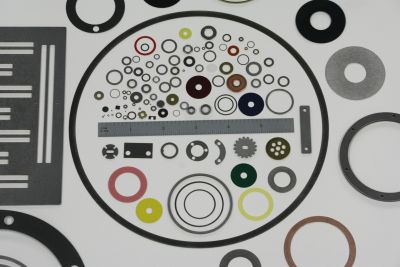
Every engineering project requires fastening solutions, but determining whether to use standard or custom flat washers can significantly impact your assembly’s performance and cost. We’ve been manufacturing both standard and custom flat washers since 1919, giving us unique insight into when each option makes the most sense. The decision involves balancing factors including availability, cost, lead time, and technical requirements.
Standard flat washers offer immediate availability and lower unit costs for common sizes and materials. However, many applications demand special-sized flat washers or custom geometries that don’t exist in standard catalogs.
Learn more about the trade-offs between each option, including cost considerations, lead times, and performance factors. By understanding these differences, you’ll make informed decisions that balance technical requirements with budget constraints.
Understanding Standard Flat Washer Limitations
Standard flat washers follow established dimensional specifications, such as ANSI B18.22.1 and SAE J478, that define the outer diameter, inner diameter, and thickness for each nominal fastener size. These specifications enable manufacturers to produce high volumes, making washers readily available through distributors at low unit costs. The standardization creates a mature supply chain with multiple competing sources.
However, standard catalogs typically offer only 200-300 size combinations across limited materials, such as zinc-plated steel and 300-series stainless steel. The thickness options rarely exceed 4 or 5 for any given outer diameter, limiting design optimization. When your design requires dimensions between standard sizes or specific material grades, standard washers fall short of performance requirements.
We frequently encounter engineers who compromise their designs to accommodate available standard washers rather than specifying optimal dimensions. This approach can lead to overweight assemblies, inadequate load distribution, or improper spacing, all of which affect system performance. Understanding standard washer limitations helps you recognize when custom solutions would better serve your project and justify the additional investment.
When Standard Flat Washers Are the Right Choice
Standard flat washers make sense in specific scenarios where their limitations don’t compromise performance:
- Non-Critical Applications: Furniture assembly, general equipment mounting, and decorative hardware where precise dimensions and specialized materials aren’t structurally necessary for safety or performance requirements
- Immediate Availability Requirements: Emergency repairs, maintenance situations, and rapid prototyping where lead time is more critical than optimal dimensional specifications and waiting 2-4 weeks for custom parts isn’t feasible.
- High-Volume Low-Cost Projects: Consumer products, basic assemblies, and applications where unit cost drives decisions and engineering optimization provides minimal value relative to the cost increase
- Common Fastener Sizes: Standard #6, #8, #10, 1/4″, 3/8″, and 1/2″ bolts in typical steel or stainless steel, where catalog dimensions adequately match bearing surface requirements
These scenarios represent situations where standard metal flat washers deliver acceptable performance at optimal cost without engineering compromises. The convenience of immediate availability through local distributors eliminates lead time and minimum order quantities. For many non-critical applications, investing in custom engineering and tooling cannot be justified economically.
Standard Washer Availability and Sourcing
Local hardware stores stock the most common standard washer sizes in zinc-plated steel and stainless steel for immediate purchase. Industrial distributors maintain broader inventories, including different finishes, materials, and less common sizes for specialized needs. Online suppliers have further expanded access to specialty standard washers that would have been difficult to source historically.
The supply chain for standard washers is mature and reliable, with multiple competing sources for any common specification keeping prices low. This competition ensures high availability for standard sizes across geographic regions. However, the moment you require a non-standard dimension, this advantage disappears entirely, and custom manufacturing becomes necessary.
Why Custom Flat Washers Become Necessary
Four primary factors drive most custom flat washer requirements we encounter:
- Optimal Load Distribution: Standard washers rarely provide ideal outer-to-inner diameter ratios for your specific assembly, potentially causing bearing stress concentrations, substrate crushing, or joint failure under design loads that compromise safety and reliability
- Space Constraints: Modern compact designs often cannot accommodate standard washer outer diameters, requiring special size flat washers machined to precise dimensional limits that fit within tight packaging envelopes
- Unique Materials: Aerospace, medical, and corrosive applications demand exotic alloys like titanium, Inconel, phosphor bronze, or specialty plastics not available in standard catalogs
- Precision Tolerances: Critical assemblies need thickness tolerances of ±.0005″ and diameter tolerances of ±.001″ that standard stamped washers cannot reliably achieve through conventional manufacturing processes
Each factor represents a legitimate engineering need that cannot be satisfied through standard catalog products without compromising performance. Attempting to force-fit standard washers into these applications compromises performance, safety, or reliability. Custom flat washers eliminate these compromises by providing exactly what your application requires.
Types of Customization Available
Dimensional customization represents the most common modification, where we manufacture washers with customer-specified diameters and thicknesses, filling gaps between standard catalog dimensions. These special-sized flat washers optimize fit and performance for unique applications. We can hold tolerances as tight as ±.0005″ on thickness and ±.001″ on diameters when precision assemblies demand strict dimensional control.
Material customization expands options beyond the zinc-plated steel and 300-series stainless available as standards in typical industrial catalogs. We stock over 40 different materials, including copper, brass, aluminum, exotic steels, and various plastics. Each material offers specific benefits, such as corrosion resistance, conductivity, weight reduction, or temperature resistance.
Geometric customization includes non-circular shapes like slotted washers, square washers, and completely custom profiles for unique applications. Our EDM manufacturing process can produce almost any flat geometry up to 12″ in length with complex features. Surface treatments, including anodizing, plating, heat treating, and coatings, provide additional functional or cosmetic enhancements.
No Tooling Charges at Brewster Washers
Unlike many custom manufacturers, we don’t charge separate tooling fees for custom flat washers. Our EDM process allows us to produce virtually any geometry without dedicated stamping dies, requiring significant upfront investment. This eliminates the tooling investment barrier that makes small-quantity custom washers prohibitively expensive at other suppliers.
We absorb tooling costs into the per-unit pricing, making custom washers economically viable even for prototype quantities of 25-100 pieces. Once we’ve created tooling for your design, we store it indefinitely for future orders at no additional charge. This means your repeat orders receive the same pricing, with no setup charges or minimum order quantities.
Cost Comparison: Standard vs. Custom Flat Washers
Understanding the complete cost picture requires looking beyond unit prices:
- Standard Washer Costs: Unit prices from $0.02-$0.50 with no minimum orders, available immediately from distributors with same-day or next-day shipping for urgent needs and local pickup options
- Custom Washer Costs: Unit prices from $0.15-$5.00 depending on material, quantity, and complexity, with no tooling charges and typical lead times of 2-4 weeks for first-time orders
- Total Project Costs: Custom washers may cost 3-10x more per unit, but can reduce assembly time, eliminate secondary operations, and improve performance to offset the premium through total cost of ownership
- Long-Term Value: Optimized custom washers often reduce warranty claims, extend service intervals, and enable lighter-weight designs that deliver ROI beyond initial purchase price considerations
This cost analysis shows that unit price represents only one factor in the total cost equation for engineered assemblies. Custom flat washers often deliver better overall value despite higher per-piece prices through performance improvements. Engineers must evaluate the full lifecycle cost, including assembly labor, failure rates, and system-level performance improvements.
Inventory Management Strategies
Four primary approaches help balance availability against inventory investment:
- Just-In-Time Ordering: Place orders 4-6 weeks before needed to receive custom washers without maintaining inventory, ideal for consistent production schedules with predictable demand patterns
- Safety Stock Approach: Maintain 2-3 months of custom washer inventory to protect against supply disruptions, appropriate for critical assemblies where downtime costs exceed inventory carrying costs
- Blanket Purchase Orders: Commit to annual quantities with scheduled monthly deliveries to lock in pricing while minimizing on-hand inventory investment and administrative overhead
- Vendor-Managed Inventory: Partner with your washer supplier to monitor usage and automatically trigger replenishment orders, reducing administrative burden and stockout risk
These inventory strategies help customers balance availability requirements with capital tied up in purchased components to optimize cash flow. The right approach depends on production volume, storage capacity, and the criticality of the washers to assembly operations. We work with customers to develop inventory plans that minimize both stockout risk and excess inventory costs.
Making the Standard vs. Custom Decision
Start by evaluating whether standard catalog dimensions adequately match your bearing surface requirements through engineering calculations. Calculate the bearing stress using your applied loads and standard washer dimensions to determine if stress levels remain acceptable.
Next, assess whether standard materials meet your environmental and functional requirements, including corrosion resistance, temperature limits, electrical conductivity, and magnetic properties. Special applications often demand materials unavailable in standard washer catalogs that justify custom manufacturing. Consider the operating environment carefully when making material selections.
Finally, weigh the cost premium of custom washers against the value they deliver through performance improvement, weight reduction, or assembly simplification in your specific application. A $0.50 custom washer that eliminates $2.00 of assembly labor makes obvious economic sense. Request quotes for both options to make informed decisions based on actual pricing rather than assumptions.
Get Expert Guidance on Your Washer Selection
We’ve helped thousands of engineers navigate the standard versus custom washer decision over our 100+ year history serving diverse industries. Send us your design specifications, and we’ll provide quotes for both standard alternatives and fully optimized custom solutions with technical justification.
Contact us today to discuss your flat washer requirements and receive expert guidance tailored to your application.